Mark O’Callaghan
November, 2025
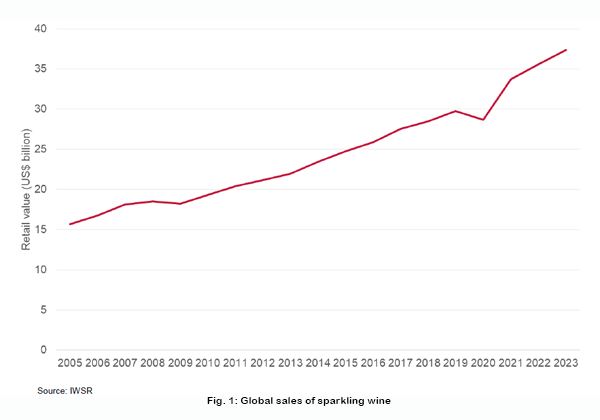
What would you say if I told you there was a wine category that had been in straight line growth for 20 years amongst a price range that can be done with volume, margin and relatively low working capital? That I was crazy?
What if I told you that same category was dominated by brands perceived (perhaps unfairly) as relatively beige, making them vulnerable? Well, the data is compelling and it might be wise to understand it before your competitors do.
There are many good sources but two recent reports in particular are worth reading: Wine Australia’s Market Bulletin on sparkling wine sales and the State of the Grapes report from the Endeavour Group.
Principal amongst them is this chart (Fig. 1) from Wine Australia (via IWSR) that shows the steady global growth of sparkling wine consumption over the last 20 years. We all know there are many challenges and layers to it but there are very few – if any – wine styles that can make the same claim. If that’s not enough to get your attention, the demographic underpinnings (see the Endeavour report) suggest that there’s every reason to believe it will continue and growth is in the A$20-A$30 range. This zone steers clear of the profitless charnel house at the bottom of the market, sits neatly above the main prosecco range and continues to benefit from rising Champagne prices. It should come as no surprise that there is very little sold above $50 anyway, even though the top end Australian sparkling wines are on fire at the moment.
Please forgive me for stating what should be obvious but being on top of costs is critical. At A$25 per bottle there are only a handful of fully automated robotic sites around the world that can do bottle-fermented winemaking (traditional method and transfer) without going broke. Everyone else needs to be more realistic. There are still plenty of things one can do to fine-tune entry level sparkling wines to make something perfectly delicious and bring customers a little joy without over-making them and losing money. We’ve helped clients do exactly that over the years and the wines have become some of the most profitable SKUs in their portfolios. I still shake my head when I scan the sparkling section in chain stores, knowing how most of these wines are made and making note of who is going backwards. Spoiler alert: it’s not the glass manufacturer, the retailer or the ATO.
We’ve presented workshops on these topics in the past, covering the full spectrum from commercial offerings to very expensive prestige cuvées but the only topic in town at the moment is profitability. With that in mind, we are running two sparkling wine workshops in December in the Yarra Valley and in Sunbury – these are very commercially focused, exploring these opportunities and what you need to know from a business, winemaking and viticulture perspective to make sparkling wine that is profitable and adds flexibility to your portfolio.
If it was easy, then everyone would already be doing it of course but the fundamentals of the business case are still pretty exciting. With so much of the wine world being so brutal at the moment, just being able to use positive language like this is refreshing.